 Vancouver Trip Guide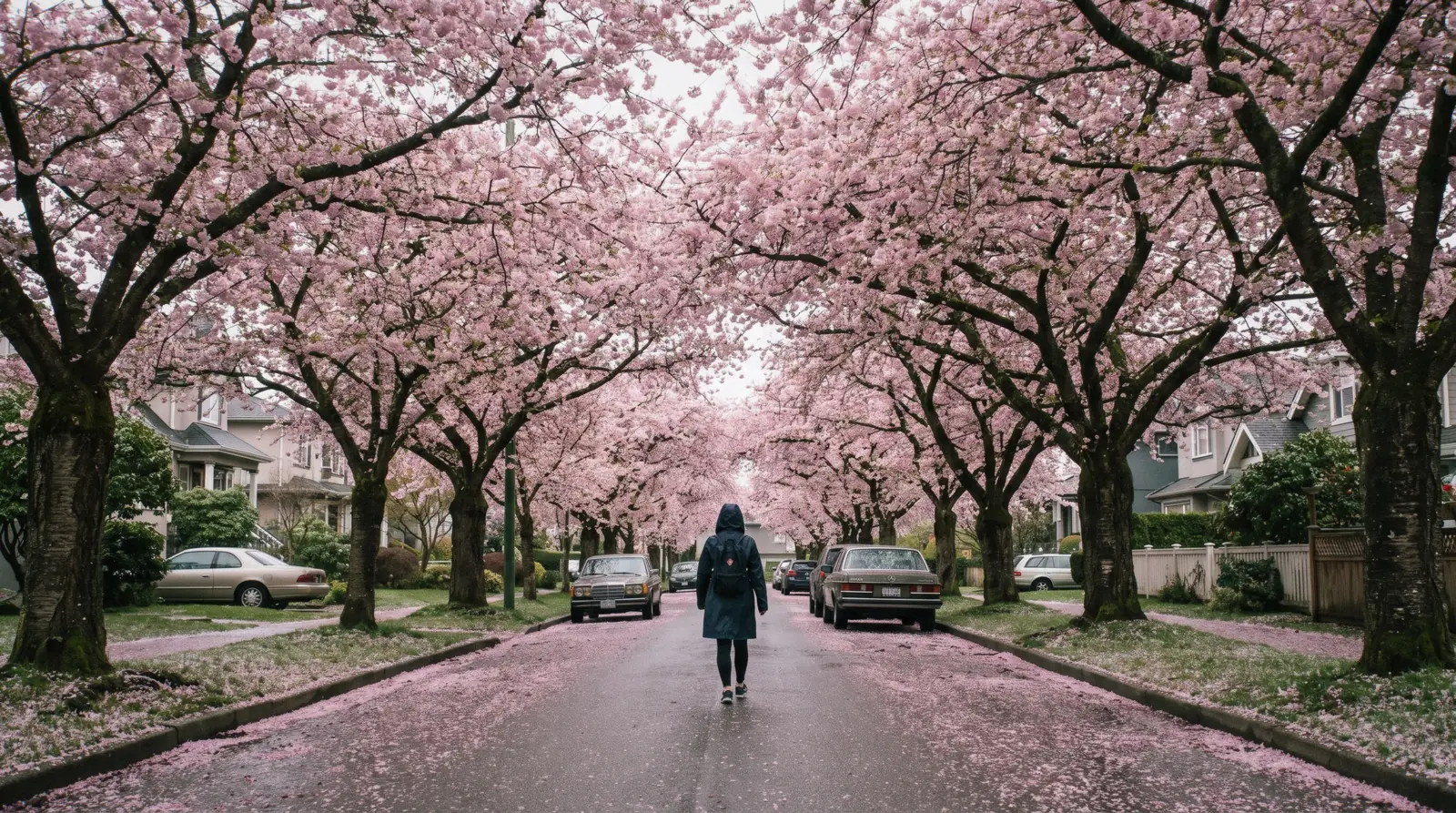
Vancouver Cherry Blossoms
The Vancouver cherry blossoms are not one week and they are not one tree. Fifty-four cultivars flower here in a sequence that starts in late February and finishes in early May, which is why two visitors a fortnight apart can both be right about when the city is at its best and both be looking at different flowers. This page sets out the order the cultivars open in, using the Vancouver Cherry Blossom Festival's own bloom records, explains which locations are actually published and which are somebody's blog list, and deals with the tree count that every guide prints and nobody can source. The weather behind these weeks is on the best time to visit page and the rest of the spring calendar is on the events calendar.
Quick answer The two waves, how long a tree lasts, and what the Festival actually publishes
Vancouver's cherry season runs in waves from late February to early May rather than peaking once. The pale pink Akebono opens in late March, the dark pink Kanzan follows a couple of weeks later in April, and each individual tree flowers for about two weeks. The Festival has recorded 54 cultivars across the city, and the last of them are still out on the seawall in early May.
Key takeaways
- If you can only pick one fortnight, take the first half of April: it catches the tail of the Akebono and the opening of the Kanzan, which is the pairing most photographs are made of. The cultivar order has the whole sequence.
- The only published inventory of where the trees are is the Festival's own Blossom Maps at finder.vcbf.ca. Everything else circulating as a best-spots list is somebody's list, and this page says which is which.
- Do not trust the tree count you have read. The 43,000 figure belongs to the Festival, not the City, and the City's own cherry blossom page now returns a 404. Why that matters.
- Blossom season is also the cheap season in the gardens: VanDusen's adult rate is CA$11.19 until 31 March and CA$15.81 from 1 April, which is a live consideration if Queen Elizabeth Park or the botanical garden is on your list.
- The flat way to cover several neighbourhoods in an afternoon is on two wheels: the half-day city e-bike tour links the downtown parks and the waterfront.
The Tree Count Nobody Can Source
Every Vancouver blossom article opens with the same number: 43,000 cherry trees. It is worth knowing where that figure comes from, because it does not come from the City.
The 43,000 is the Vancouver Cherry Blossom Festival's own figure, published in its FAQ, where the Festival describes celebrating spring when 43,000 cherry trees burst into bloom across the city. The Festival is a credible organisation with volunteer Cherry Scouts who survey the trees, and the number may well be right. But it is an advocacy body's figure rather than a municipal inventory, and this guide does not present a campaign number as a civic statistic.
What the City of Vancouver actually publishes is different and more modest in scope: 150,000 street trees and 36,000 specimen trees in its golf courses and urban parks, and more than a million trees across 444 hectares of public forest. None of those figures is broken out by species. And the City's own cherry blossoms page, the one that used to carry the seasonal information, now returns the site's 404 error.
So the honest sentence is this one: nobody in municipal government publishes a cherry tree count for Vancouver, and the number in circulation is the Festival's. That is a better fact than the number itself, because it tells you which sources on this subject have actually been checked. What the Festival does publish, and what this page leans on instead, is a survey of cultivars: its Cherry Scouts have identified 54 different ornamental cherry cultivars growing in the city.
https://vcbf.ca/faq/ for the Festival's figure and the cultivar count; https://vancouver.ca/streets-transportation/street-trees.aspx for the City's tree totals; the former City cherry blossoms URL now returns a 404. All read in Q3 2026.
The Cultivar Order, Which Is What Decides Your Dates
The Festival records what is flowering, where and when, through its own bloom reports. This is the sequence those reports describe, with the neighbourhoods the Festival itself names for each cultivar.
Read this as a relay rather than a peak. No single date catches all of it, and no year runs exactly to schedule, because a warm February pulls the whole sequence forward.
| Cultivar | Typical window | Where the Festival records it | What it looks like |
|---|---|---|---|
| Okame | Late February to early March | Scattered; the earliest of the season | Small, deep pink, the first sign of anything |
| Akebono | Late March | David Lam Park, Kitsilano, Downtown, Kensington-Cedar Cottage, Riley Park | Pale pink, the classic canopy tree, the one on most postcards |
| Beni-shidare | End of March | The Great Lawn at VanDusen, Shaughnessy | Weeping form, deep pink |
| Somei-yoshino | Late March into early April | West Vancouver, Burnaby, Kerrisdale | Almost white, the Japanese standard cultivar |
| Shirotae and Washi-no-o | Early April | New Westminster, Queen's Park | White, flat-topped, heavily scented |
| Taihaku | Early April | Sunset | Great white cherry, unusually large flowers |
| Ichiyo and Ukon | Mid April | Victoria-Fraserview, Surrey and North Delta, Kerrisdale | Ichiyo pale pink; Ukon the pale green-yellow one people photograph twice |
| Kanzan | Mid to late April | Killarney, Dunbar-Southlands | Dark pink, double flowers, the heavy street canopy |
| Avium Plena | Mid to late April | Marpole, Riley Park, Sunset | White double flowers on tall trees |
| Shiro-fugen | Late April into May | Hastings-Sunrise, the English Bay seawall | Opens pink, fades to white, the last of the big ones |
The Festival's own summary of the shape is that in a typical warm year the early cultivars bloom first around early March, followed by the popular light pink Akebono in late March and a dark pink Kanzan a couple of weeks after that in April, with each tree blossoming for about two weeks.
Two consequences follow for a visitor. First, mid-April is not too late: it is the middle of the Kanzan, which is the wave that produces the tunnel-of-pink residential streets people come for. Second, a trip built entirely around the last week of March is a gamble on one cultivar in one year, and a fortnight that straddles the turn of the month catches two waves instead of one.
The latest flowering is genuinely late. The Festival's bloom reports carry Shiro-fugen on the English Bay seawall into early May and the pompom-flowered Kiku-zakura later still, so a May visitor who assumed the season was over should look along the waterfront before believing it.
Vancouver Cherry Blossom Festival bloom records at https://vcbf.ca/blooming-now/ and https://vcbf.ca/faq/ , read in Q3 2026. Cultivar windows are the Festival's own observations, not a forecast.
Where to Look, and Which Lists Are Real
This is where most blossom articles quietly stop citing anything. There is no official municipal ranking of Vancouver's blossom streets, no City map of the best trees, and no tourist board list with a source attached. What exists is one genuine inventory and a great deal of repetition.
The inventory is the Festival's Blossom Maps, an interactive map at finder.vcbf.ca that the Festival calls a cherry compass, built on the Cherry Scouts' surveys and linked from the Festival's own homepage. It is the only tool that will tell you which cultivar is where, which matters far more than a list of parks once you understand the sequence above. Alongside it the Festival publishes bloom reports naming the neighbourhoods where each cultivar is out.
The places the Festival itself names, in its bloom records and its event listings, are the defensible ones. David Lam Park in Yaletown carries Akebono in late March and hosts the Festival's own free evening event. VanDusen's Great Lawn carries the weeping Beni-shidare at the end of March. Queen's Park in New Westminster carries Washi-no-o in early April. The English Bay seawall carries the late Shiro-fugen into May. Kitsilano, Downtown, Shaughnessy, Kerrisdale, Riley Park, Killarney, Dunbar-Southlands, Marpole, Hastings-Sunrise and Victoria-Fraserview all appear in its records by cultivar and week.
Beyond that, the widely shared spot lists that name individual residential blocks are travel writers' lists rather than published inventories, and this guide will not launder them into facts by repeating them without a source. If you want individual streets, use the Festival's map on the day rather than a list written in another year, because a street planted with one cultivar is spectacular for a fortnight and bare for fifty weeks.
Two Places Worth the Trip Anyway
Two of the Festival's named locations are worth building a morning around regardless of which week you land in, because both are worth seeing on their own terms.
The park on the city's highest point holds a formal garden in an old quarry and the glass dome of a conservatory at the top, and the blossom there is part of a planted landscape rather than a street planting. Admission to the park is free; the conservatory is CA$9.50 before tax. The Queen Elizabeth Park page and the Bloedel Conservatory page cover both.
VanDusen Botanical Garden, ten minutes away on Oak Street, has the weeping cherry on its Great Lawn and hosts the Festival's one ticketed event in April. Its adult admission is CA$11.19 from January to March and CA$15.81 from April to October, published before tax, which is why the odd cents. Buying online in advance saves CA$1 on the adult ticket.
Festival maps at http://finder.vcbf.ca ; bloom records at https://vcbf.ca/blooming-now/ ; VanDusen and Bloedel rates from vandusengarden.org. Read in Q3 2026.
The Festival, and What It Costs
The Vancouver Cherry Blossom Festival is run by its own society and describes more than twenty cherry-blossom-themed community events every year across March and April. Its own statement on money is unambiguous: most of its events are free and marked as such, the only event requiring tickets for admission is the Sakura Days Japan Fair, and the Blossom Block Party asks for a suggested CA$5 admission by donation.
The signature free event is Blossoms After Dark at David Lam Park, 1300 Pacific Boulevard, which the Festival states outright is a free outdoor event with no ticket required. The ticketed one, Sakura Days Japan Fair, is held at VanDusen Botanical Garden; the Festival publishes no price for it and refers visitors to the Fair's own site. The programme also carries a haiku exhibition and invitational, guided tree talks and walks, workshops, Bike the Blossoms, the Big Picnic and pop-up events.
Exact dates are the gap. When this page was written the Festival published only that its next outdoor festival will run in March and April 2027, with no specific dates given for the season and none published for 2026 either. That is not evasion on the Festival's part so much as biology: the events follow the bloom, and the bloom follows the weather. Plan the fortnight from the cultivar table above and check the Festival's site for the specific days once you are inside a month of travelling.
https://vcbf.ca/faq/ , https://vcbf.ca/the-festival/ , https://vcbf.ca/blossoms-after-dark/ and the Festival's Sakura Days Japan Fair page, all read in Q3 2026.
Why There Are Cherry Trees Here at All
The trees are a gift with a war behind them. In 1925 the mayors of Kobe and Yokohama presented the Vancouver Park Board with five hundred trees of the Ojochin variety, for planting at the cenotaph in Stanley Park, in honour of Japanese Canadian veterans of the First World War. That is the Festival's own account of the origin, and it is the reason the oldest planting in the city stands beside a war memorial rather than in a botanical garden.
What followed was municipal rather than ceremonial. Vancouver kept planting ornamental cherries through the middle of the twentieth century as street trees, which is why the spectacle here is residential rather than concentrated: the flowering happens over people's parked cars, along bus routes and outside schools, in fifty-four different varieties that nobody coordinated. It is a city-wide accident of planting policy, and it is more interesting than a formal avenue.
The Japanese Canadian history behind that 1925 gift is not decoration on this story. It sits alongside the internment and dispossession of the 1940s, and the community that the trees honour was the community removed from this coast two decades later. The Chinatown page covers the neighbouring history in the streets where much of that story played out.
https://vcbf.ca/history-of-our-cherry-trees/ , read in Q3 2026.
Planning a Blossom Week
Four practical things about visiting in March and April, with the figures behind each.
Blossom season sits inside the wettest half of the shoulder, and the arithmetic of the visit reflects that.
| What | March | April | Why it matters |
|---|---|---|---|
| Average daily high | 8.8°C (48°F) | 12.0°C (54°F) | Cold enough that a long photography morning needs layers |
| Rain | 114 mm over 17.8 wet days | 89 mm over 14.8 wet days | Petals hold better in drizzle than in wind |
| VanDusen adult admission | CA$11.19 before tax | CA$15.81 before tax | The band flips on 1 April, mid-season |
| Garden hours | 10 a.m. to 5 p.m. | 9 a.m. to 5 p.m. | April opens an hour earlier for morning light |
| Events in the way | Festival events through the month | Vaisakhi Parade, Saturday 11 April | Road closures 7 a.m. to 8 p.m. in South Vancouver that day |
Three habits make the week work. Move by transit and on foot, because the trees are spread across residential neighbourhoods rather than gathered in one park, and a car turns a blossom morning into a parking problem: an all-day transit DayPass costs CA$12.55 and the fares are on the transit guide. Go early, both in the day and in the wave, since a Kanzan street at 8 a.m. is a different photograph from the same street at noon. And do not chase a forecast peak: with each tree flowering about two weeks and ten cultivars in sequence, any week from late March to late April has something at its best somewhere in the city.
One local note about etiquette that has made the news across the water in Richmond: the trees are street plantings in residential neighbourhoods, and the request from the municipalities is the obvious one, which is not to pull branches down for a photograph. Nothing about this season is ticketed or fenced, which is precisely why it depends on people behaving.
Temperatures from the Open-Meteo ERA5 archive 1995 to 2024; rainfall from Environment and Climate Change Canada normals at Vancouver International; garden rates and hours from vandusengarden.org; Vaisakhi road closures from vancouver.ca. Read in Q3 2026.
Three Half Days, Built From the Festival's Own Records
Each of these strings together locations the Festival names for that stretch of the season, and each is one transit fare wide. Walking times are our estimates from the addresses.
Late March, Downtown and Yaletown
This is the Akebono fortnight, and it is the one that happens closest to where visitors sleep. Start at David Lam Park on Pacific Boulevard, where the Festival records Akebono in late March and holds its own free evening event, and walk the False Creek shoreline path east. The Festival's bloom records also carry Akebono in Downtown and Kitsilano in the same window, so a walk that continues over the Burrard or Granville bridge picks up a second neighbourhood without a bus.
Finish at the Granville Island Public Market, which opens at 9 a.m. daily, or carry on along the water into the West End.
Early April, the Cambie Corridor
Two gardens and a hill, on one bus route or one SkyTrain line south. Queen Elizabeth Park sits on the highest point in the city with a formal garden in a disused quarry and the glass dome of the conservatory at the top, admission to the park free and the conservatory CA$9.50 before tax. Ten minutes further, VanDusen Botanical Garden carries the weeping Beni-shidare on its Great Lawn at the end of March and opens at 9 a.m. from April, with adult admission at CA$15.81 before tax from the first of the month.
Between them they cover a morning, and neither depends on a specific street being in flower.
Mid to Late April, the Residential East and South
The Kanzan wave is a neighbourhood event rather than a park one. The Festival's records name Killarney and Dunbar-Southlands for Kanzan in mid to late April, Marpole and Riley Park for the white Avium Plena in the same weeks, and Victoria-Fraserview for Ichiyo in mid April. This is the half day that needs the Festival's map open on a phone rather than a fixed itinerary, and it is the reason a DayPass at CA$12.55 is the right ticket: you are crossing the city by bus between residential streets, not walking a loop.
Locations and cultivar weeks from https://vcbf.ca/blooming-now/ ; garden rates and hours from vandusengarden.org; fares from translink.ca. Read in Q3 2026.
What Else Is Flowering at the Same Time
Blossom season overlaps with the point at which Vancouver's gardens come back to life after their short winter hours, and three of them are worth the trip in the same weeks.
Nitobe Memorial Garden on the University of British Columbia campus is the one to know about. It was established in 1960 to honour Dr. Inazo Nitobe, designed by Kannosuke Mori, and is described by the university as one of the most authentic Japanese gardens outside Japan. Adult admission is CA$10, seniors, students and youths aged six to seventeen CA$8, children under six free, and a family of two adults and up to four children CA$25. A combined ticket with the neighbouring UBC Botanical Garden costs CA$22.50 for an adult and CA$54 for a family, which is a 20 percent saving on the Nitobe portion. Opening hours run Tuesday to Sunday, closed Mondays, from 10 a.m. to 4:30 p.m. through October and 10 a.m. to 2 p.m. in winter.
UBC Botanical Garden next door charges CA$14.50 for an adult in summer, CA$10 for seniors, students and youths, and CA$35 for a family of two adults and four children, with the Greenheart TreeWalk sold as a combined ticket at CA$29.50 for an adult. Winter admission drops to CA$5 per person for everyone, and the TreeWalk closes for the winter months entirely.
And the conservatory at the top of Queen Elizabeth Park runs the same all year: more than five hundred plants from tropical and subtropical rainforest habitats under one dome with free-flying birds, at a flat CA$9.50 before tax with no seasonal band, which makes it the reliable fallback on a wet blossom afternoon. The rainy day page has the rest of the indoor list. Where this sits in a full itinerary is set out on visiting Vancouver, Canada.
botanicalgarden.ubc.ca and its Nitobe Memorial Garden pages; vandusengarden.org for Bloedel. Read in Q3 2026.
Four Ways to Cover the Blossom Neighbourhoods
The trees are spread across the whole city, so these are chosen for ground covered rather than for the flowers: two rides, one city loop and one walking tour of the neighbourhoods the Festival maps. Prices, ratings and review counts as listed in Q3 2026.
 from $104.69
Top rated
from $104.69
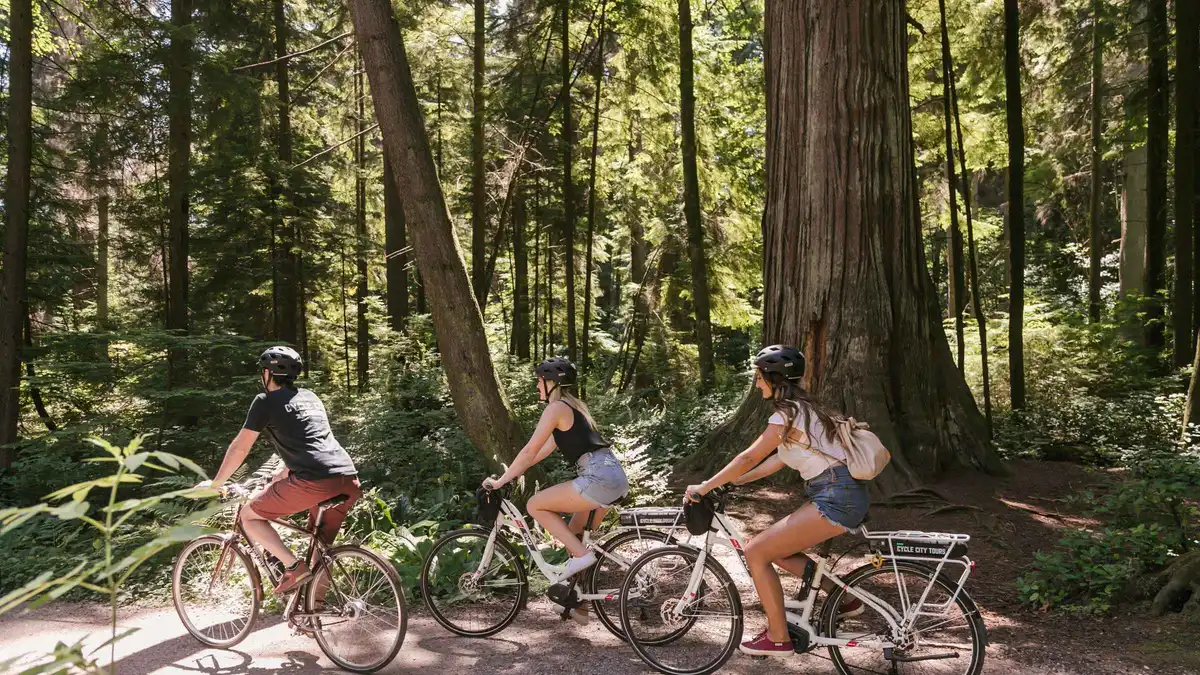
Top rated Vancouver: Half-Day City Highlights E-Bike Tour Age 16+
Four hours on an e-bike through Stanley Park to Prospect Point, then Yaletown, Olympic Village, Chinatown and Gastown, almost all of it away from traffic. Riders must be 16 or over and able to handle light exercise.
Check Availability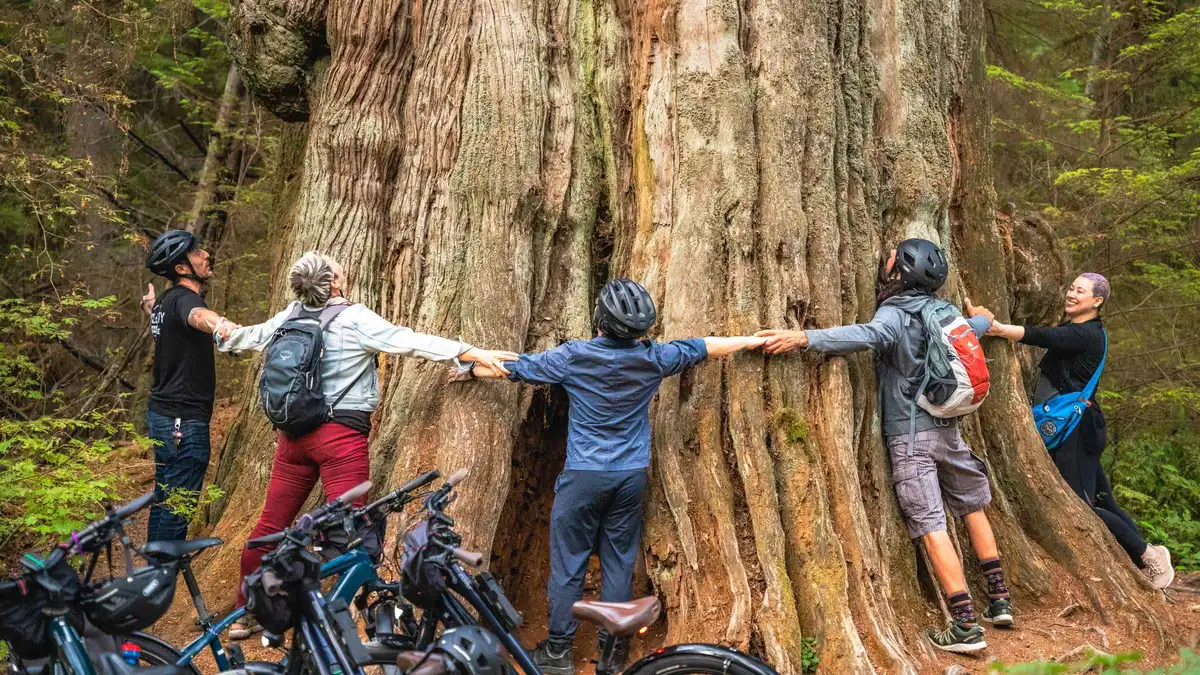 from $75.70
Top rated
from $75.70
Top rated Vancouver: Stanley Park Bicycle Tour
Three hours and 12 flat kilometres through the West End, English Bay and Stanley Park with a guide who stops for the totem poles, Beaver Lake and the forest trails. Bike and helmet are included; e-bike upgrades are in-store only.
Check Availability from $50.12
Top rated
from $50.12
Top rated Vancouver: Hop-On Hop-Off City Tour, SMALL GROUP "12 STOPS"
A hop-on hop-off route run in 15-seat vans rather than buses, with 24, 48 and 72 hour passes and 12 to 17 stops depending on the pass. The driver is not a guide and no attraction tickets are included.
Check Availability from $5
Vancouver Uncovered: Downtown History & Culture Walk
Three hours on foot through downtown with a local guide covering architecture, street art and how the neighbourhoods fit together. Gratuities are not included and cash is listed among what to bring.
Check AvailabilityPrices, ratings and details are the platform's own, checked in Q3 2026; dollar figures are the listed prices — the platform bills in your account's currency.
Around the Blossom Season
Three pages for a spring trip.
Whether spring is your month
The full weather picture and what else changes price on 1 April: the best time to visit Vancouver.
March 114 mm, April 89 mmWhat else is on in March and April
The parade that closes roads, the night market that opens, and the rest of the spring calendar: Vancouver events.
Vaisakhi: Saturday 11 AprilThe parks the trees stand in
The quarry garden and the conservatory dome on the city's highest point: Queen Elizabeth Park, and the rest at things to do.
Free park, CA$9.50 conservatoryVancouver Cherry Blossoms: Questions
When do the cherry blossoms bloom in Vancouver?
In waves from late February to early May. The Festival's own summary is that early cultivars open around early March in a typical warm year, the pale pink Akebono follows in late March and the dark pink Kanzan a couple of weeks later in April. The earliest, Okame, can be out in late February and the last, Shiro-fugen, is recorded on the English Bay seawall into May. The cultivar table sets out the full order with the neighbourhoods for each.
Is mid-April too late to see cherry blossoms in Vancouver?
No. Mid to late April is the Kanzan wave, the heavy dark pink double flowers that make the residential tunnels people photograph, and Ichiyo, Ukon and Avium Plena are out in the same fortnight. What you miss by then is the Akebono, which peaks in late March. If your dates are fixed for the middle of April, you are in the second of the two big waves rather than after the season.
How many cherry trees are there in Vancouver?
Nobody official says. The 43,000 figure printed everywhere is the Cherry Blossom Festival's own, published in its FAQ, and the City of Vancouver publishes no cherry tree count at all: its street trees page gives 150,000 street trees and 36,000 specimen trees without a species breakdown, and its old cherry blossoms page now returns a 404. What the Festival does document is 54 cultivars identified across the city by its volunteer Cherry Scouts. The full explanation is here.
Where are the best places to see blossom in Vancouver?
The only published inventory is the Festival's own Blossom Maps at finder.vcbf.ca, which shows what is flowering where by cultivar. The locations the Festival itself names in its bloom records include David Lam Park in Yaletown for the late March Akebono, VanDusen's Great Lawn for the weeping Beni-shidare, the English Bay seawall for the late Shiro-fugen, and the Kitsilano, Shaughnessy, Kerrisdale, Killarney and Dunbar-Southlands neighbourhoods by week. Which lists are real explains why this page does not print a ranking of individual streets.
Is the Cherry Blossom Festival free?
Mostly. The Festival states that most of its events are free and marked as such, that the only event requiring tickets for admission is the Sakura Days Japan Fair at VanDusen Botanical Garden, and that the Blossom Block Party asks a suggested CA$5 by donation. Its signature evening event, Blossoms After Dark at David Lam Park, is explicitly free with no ticket required. No price is published for the Japan Fair on the Festival's own pages.
How long does an individual cherry tree stay in flower?
About two weeks, on the Festival's own figure. That is why the city's season lasts more than two months while any single street is spectacular for a fortnight: ten or more cultivars flower in sequence rather than together. It also means that a forecast of peak bloom for one location tells you almost nothing about another neighbourhood planted with a different variety, which is what the Festival's map is for.
The Blossom Season on Film
Three views of the season: a spot-by-spot rundown, the Festival's own free evening event, and what full bloom looks like on the street.
8 Best Cherry Blossom Spots in Vancouver
A spot-by-spot tour of the neighbourhoods the Festival's bloom records name, filmed in season.
Video: Stella CheVANCOUVER CHERRY BLOSSOMS AFTER DARK 2026 Walking Tour At David Lam Park
The Festival's free evening event at David Lam Park, walked end to end, which shows the Akebono canopy at its late March peak.
Video: Sound of FootstepsVancouver Cherry Blossoms
The city tourism body's own short film of the season, useful for seeing the scale of the street plantings.
Video: Destination VancouverVideos load from YouTube only when you press play.
Reviewed Q3 2026 (July–September 2026); next review Q4 2026. Prices, hours and terms are set by the venue or operator and confirmed at checkout.
We may earn a commission if you book through one of our links, at no extra cost to you. Full affiliate disclosure